Serving Vancouver & all of Clark County, WA Free estimates: (360) 226-9991
Vancouver Excavation Co. Get a Free Quote

Home › Utility Trenching in Vancouver, WA

Utility Trenching in Vancouver, WA

Utility trenching in Vancouver, WA for water, sewer, gas, power, and irrigation lines. Vancouver Excavation Co. digs to depth, beds, and backfills to code. Free estimates.

Licensed & insured in Washington Free on-site estimates Local Clark County crew Wet-season ready

Utility trenching in Clark County begins before a single bucket of dirt moves. Washington state law under RCW 19.122.030 requires excavators to mark the work boundary with white paint or white pin flags, then notify all facility operators through 811 at least two full business days — and no more than ten business days — before excavation starts. Vancouver Excavation Co. manages that locate sequence, then digs water, sewer, gas, power, storm, and irrigation trenches to the required depth, beds the pipe or conduit correctly, and compacts the backfill in lifts so the line stays protected.

Small mistakes in a trench become expensive after the yard is restored. A shallow line is vulnerable, poor bedding can crack pipe, and loose backfill settles into a rut. Vancouver's WWII-era housing boom — which grew the city from 18,000 to over 80,000 residents almost overnight — left behind aging sewer laterals, water services, and buried private lines in neighborhoods like Fruit Valley, Bagley Downs, and McLoughlin Heights that have long since exceeded their design life. We white-line the zone, call for locates within the RCW 19.122.030 window, hand-check near every marked utility, and backfill in compacted lifts so the surface stays put.
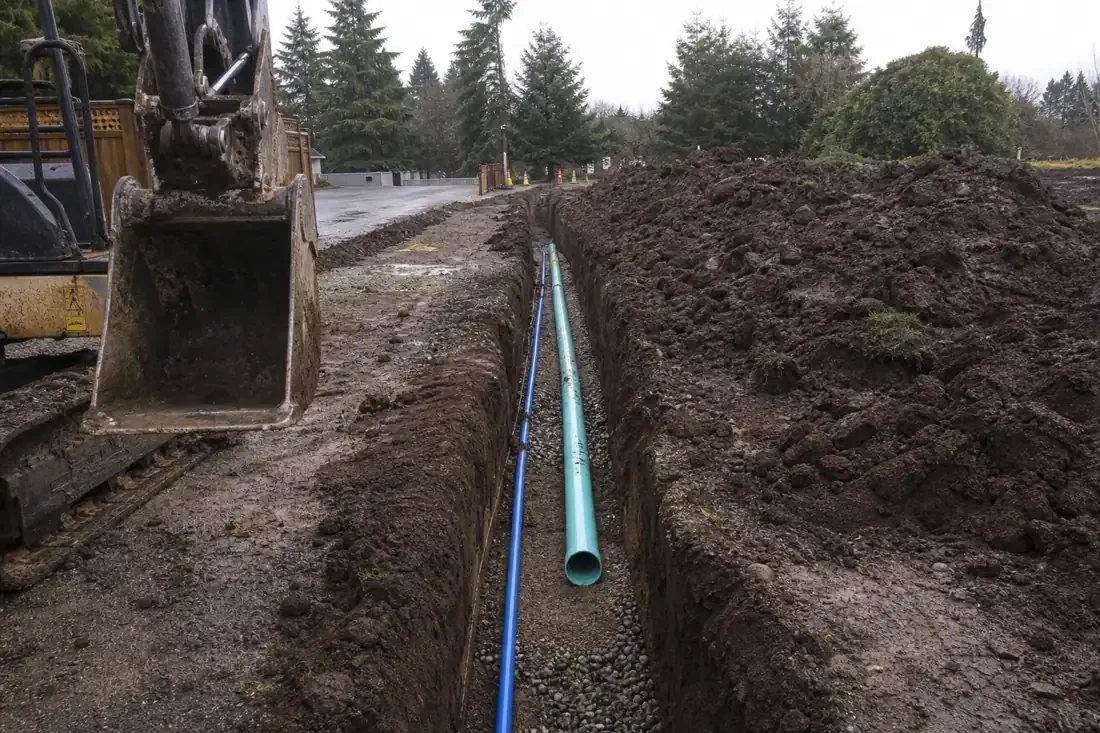
Open utility trench with new water and sewer pipe on gravel bedding in Vancouver, WA
A clean utility trench with new sewer and water line on proper gravel bedding — Vancouver, WA.

Utility Lines We Trench in Vancouver

For buried utilities, Vancouver Excavation Co. excavates, beds, and backfills the run while keeping depth, separation, and utility-company requirements aligned. We trench for:

Dug to Depth, Bedded, and Compacted Right

The white-line step under RCW 19.122.030 is not a formality — it is what makes the locate useful. Before the 811 call goes in, the excavation boundary must be staked or painted on the ground so utility locators know exactly where to look. That marks the zone they check and the lines they flag. We white-line carefully, submit the locate request inside the two-to-ten-business-day window, verify markings by hand before the machine enters the zone, and slow the dig near any live utility. Water lines go below frost depth, sewer holds its designed fall, and gas or power gets the cover and separation the utility company requires — set on sand or drain rock, not loose clay, then backfilled in compacted lifts.

We locate before we dig

Clark County yards can hold water, gas, power, cable, fiber, and old private lines in the same corridor — especially in the 1940s-era neighborhoods near Fruit Valley and Bagley Downs where infrastructure was installed fast and records are incomplete. Under RCW 19.122.030, the legal responsibility for a proper locate rests with the excavator, even when a general contractor places the 811 call. A missed line in Vancouver means real danger, repair cost, or a neighborhood service outage. We manage the locate, hand-check around every marking, and slow the machine near live utilities.

How Much Does Utility Trenching Cost in Vancouver, WA?

Trenching is priced per linear foot, and the surface above the trench matters as much as the dirt below it. An open lawn run at normal residential depth is about $12 to $30 per foot. Going deeper, hitting rock, threading between existing utilities, or cutting across a concrete driveway all move it up, because the restoration becomes its own job. Short service hookups are usually quoted flat. Clark County ranges are below for early budgeting.

Trenching scopeTypical sizeTypical Vancouver cost
Standard residential trenchper linear foot$12 – $30
Deep or rock trenchingper linear foot$25 – $60
Water or sewer service run50 – 100 ft$1,800 – $6,500
Irrigation / low-voltageper linear foot$8 – $18
Driveway / concrete cut & patchadd-on$300 – $1,500

These Clark County numbers cover the trench, the bedding the pipe sits in, backfill, and compaction. Depth is the main lever; rock, a crowded utility corridor, and putting the surface back the way it was account for most of the rest. Firm itemized quote once we have seen the run.

Permits, Locates, and Code in Vancouver

Utility trenches in Clark County require two things before the ground opens: the permit and the locate. Water and sewer runs may need plumbing or site-utility permits; power runs need the correct electrical permit and inspection. The RCW 19.122.030 locate window also has to be built into the schedule — a locate requested too early expires before the work-to-begin date. Vancouver Excavation Co. sequences locates, permits, excavation, and inspection so the trench stays open no longer than necessary and closes to the approved spec.

What Working With Us Looks Like

1. Free on-site estimate

We trace the route, verify access, depth, soil, and known buried utilities, then quote the trench by the foot or as a complete project.

2. Locate & permits

The utility locate and permit steps are coordinated before excavation so the trench is opened safely and to the inspected requirement.

3. Dig, bed, and lay

Our operators cut the trench cleanly to depth, set pipe or conduit on proper bedding, and keep the open-trench inspection on schedule.

4. Backfill & restore

Backfill is placed and compacted in lifts, then the lawn or driveway surface is restored so the route does not remain an obvious scar.

Frequently Asked Questions

How much does utility trenching cost in Vancouver, WA?

Budget $12 to $30 per linear foot for a normal-depth residential run in workable ground. Deep, rocky, congested, or pavement-crossing trenches run $25 to $60 per foot. In practice a 50 to 100 foot water or sewer service usually totals $1,800 to $6,500. We price it after confirming required depth, machine access, and what the surface restoration involves.

How deep does a utility trench need to be?

Every utility has its own answer. Irrigation sits shallow. Water has to go deep enough to stay clear of freezing. Sewer is governed by fall — it has to drop consistently the entire way or it does not work. Gas and electrical conduit follow the utility company's separation and cover rules. Around here that spans roughly 18 inches to several feet, so we dig each line to its own requirement rather than cutting one trench depth and hoping it satisfies everything.

Do you call for a utility locate before digging?

Yes, and in Washington it is statute, not a courtesy. RCW 19.122.030 requires marking the excavation boundary in white paint or white pin flags first, then notifying every facility operator through 811 — no fewer than two and no more than ten full business days before the work-to-begin date. A general contractor can make that call, but the excavator still carries the legal responsibility. On an older Vancouver lot you may have water, gas, power, cable, fiber, irrigation, and abandoned private lines sharing one yard, so we hand-dig around the marks rather than trusting the paint absolutely.

Do I need a permit for utility trenching in Vancouver?

Usually, yes. Water and sewer typically need plumbing or site-utility permits; electrical work needs its own permit and inspection. The part that catches people out is sequencing — an inspector often has to see the trench open, and the 811 locate window is two to ten business days on its own. We line up locates, permits, the dig, and the inspection so an open trench is not sitting in your yard waiting on a phone call.

Will trenching tear up my yard or driveway?

There will be a visible work path — anyone who tells you otherwise is guessing. What we control is what it looks like afterward. Backfill goes in compacted lifts so the line does not reappear as a sunken stripe next spring, lawn areas get reseeded, and any concrete or driveway crossing is quoted with the cut-and-patch included rather than added later. On tight lots we pick the machine and the route to keep the disturbance narrow.

Get Your Free Vancouver Excavation Estimate

Tell us what line you are running and where it has to end up. We will come out, look at the route, and put depth, restoration, and locate timing in writing. Call, text, or use the form — we answer the same business day.

We only use your info to contact you about your project. No spam, ever.

Prefer to talk?

Call or text to reach our team directly. During business hours we pick up when we can, and every message gets a return call.

(360) 226-9991

Hours: Mon–Sat, 7am–6pm