Home › Drainage & French Drains in Vancouver, WA
Drainage and French drains in Vancouver, WA. Vancouver Excavation Co. installs French drains, catch basins, and footing drains to stop flooding and foundation water. Free estimates.
Drainage work in Clark County is what keeps Vancouver's 42-inch annual rainfall from becoming a foundation, crawl space, or yard problem. Rain builds from fall through spring, peaks in November and December, and does not reliably stop until mid-June. During that long wet stretch, shallow groundwater near the Columbia River and along Burnt Bridge Creek and Salmon Creek can stay near the surface for months. Vancouver Excavation Co. installs French drains, catch basins, swales, curtain drains, footing drains, and downspout tie-ins to collect that water and move it to a legal outfall before it finds a structure instead.
Clark County's low western edge near the Columbia River and Vancouver Lake sits in former floodplain that has held water since long before the city was here. Heavy silty clay slows infiltration across much of the area, the seasonal groundwater table climbs from October through spring, and neighborhoods that were developed quickly during the WWII shipyard boom — Fruit Valley, Fourth Plain Village, Burton Homes — now have aging drainage infrastructure that cannot handle the 42 inches of annual rainfall. We solve saturated yards, wet crawl spaces, and persistent standing water by finding the source first, then building a system that gives the water a real path out.
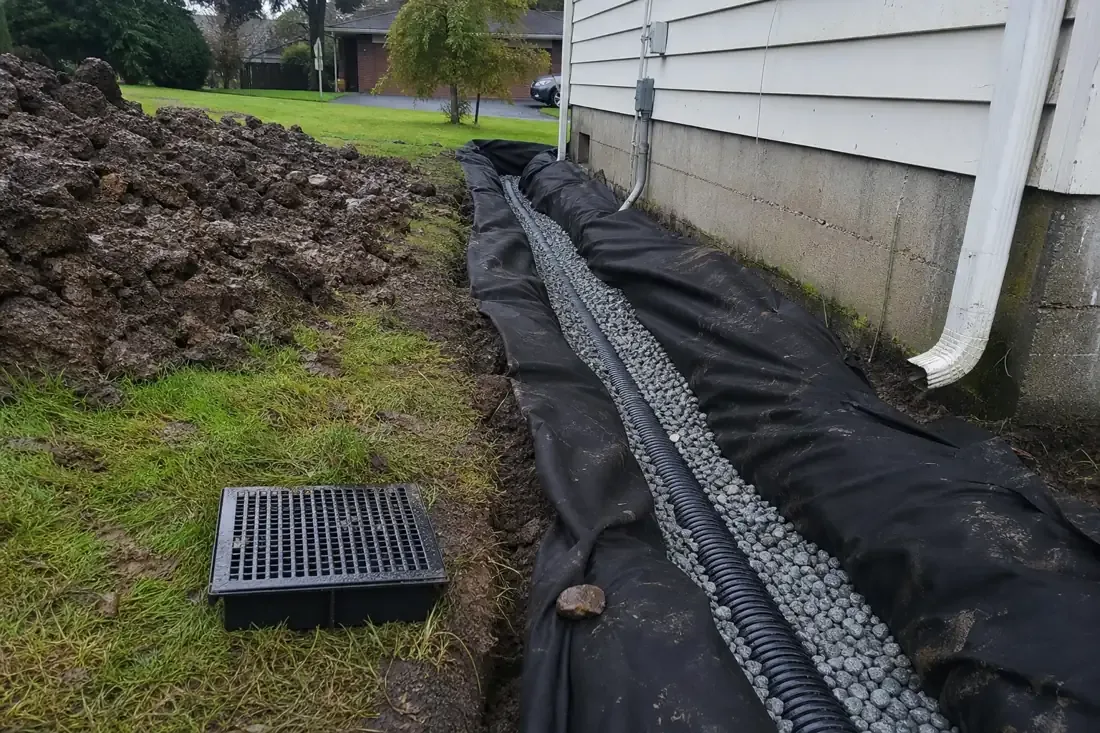
Drainage is a routing problem before it is a digging problem. We build systems for homes and light commercial sites where water needs somewhere better to go than where it is currently going. Depending on what is actually feeding the water, we install:
Water is what wrecks foundations, and Vancouver delivers it from several directions. Near the Columbia River corridor and along Burnt Bridge Creek and Salmon Creek, the water table stays close to the surface through most of the wet season. On higher ground in the Orchards and Cascade Park, runoff sheds downslope quickly into lower neighborhoods. Rain starts building in October, does not slow until late spring, and does not reliably stop until mid-June. We diagnose whether the problem is surface runoff, roof water, shallow groundwater, or a seasonal water table that rises against the foundation — and build the drain system that addresses the actual source, not a generic solution.
Clark County drainage has to be designed around the real wet-season pattern: rain from October through mid-June, high groundwater near the Columbia River bottomland, and clay soils that accept water slowly across much of the flatter terrain. Our French drains are set in clean drain rock, wrapped with filter fabric to keep clay fines out of the system, and carried to daylight or a drywell sized for local rainfall. The goal is a drain that still works after a decade of wet Clark County winters, not a shallow trench that clogs after two seasons.
Vancouver receives about 42 inches of rain concentrated across fall, winter, and spring. November and December are typically the heaviest months, and water problems show themselves between October and March when the ground is saturated and Burnt Bridge Creek and Salmon Creek are running full. The dry window — mid-June through September — is when drainage repairs are cleanest to install. French drains, outfalls, and drywells we install in Clark County are sized for that sustained wet-season volume, not for a dry climate that loses its rain in May.
Where the water goes matters as much as how we collect it. Low ground along Burnt Bridge Creek and near Vancouver Lake can stay saturated from October through spring, while higher terrain in the Orchards and Hazel Dell areas sheds runoff into neighborhoods below. We plan a legal outfall that actually carries water away from the foundation — daylight where allowed, a drywell where it makes sense, or an approved storm connection — and we size the system for a full Clark County wet season, not a summer shower.
Most residential drainage work here lands between $1,800 and $5,500. French drains are quoted per linear foot, generally $25 to $60 installed, and the swing comes from depth, how heavy the clay is, machine access, and — often the biggest factor — how far the pipe has to travel to reach a legal outfall. A lone catch basin or downspout tie-in can be a few hundred dollars. A whole-property system with several runs is a different scale of job. Clark County budgeting ranges below.
| Drainage scope | Typical size | Typical Vancouver cost |
|---|---|---|
| French drain | per linear foot | $25 – $60 |
| French drain system | 100 – 150 ft | $1,800 – $5,500 |
| Catch basin / area drain | each | $350 – $1,200 |
| Downspout tie-in | per downspout | $200 – $600 |
| Foundation / footing drain | per project | $3,000 – $9,000 |
Clark County figures, covering the trench, pipe, drain rock, filter fabric, and backfill. Depth and the distance to a workable outfall move them most, followed by rock and access. You get a firm itemized quote once we have traced where the water is actually coming from.
Drainage work in Clark County is only complete if the discharge point is legal. Water cannot simply be piped onto a neighbor's property or into the street without meeting Washington stormwater rules. Some systems need a plumbing or site permit, and connections to the public storm system require approval. Vancouver Excavation Co. plans the outfall — daylight, drywell, or approved storm connection — pulls the required permits, and installs erosion control so the repair does not create a downstream problem in Burnt Bridge Creek or Salmon Creek.
We inspect the property when the issue is visible, trace the source of the water, and provide an itemized written price for the fix.
The system and outfall are sized for the soil and water source, with any required permit handled before installation.
Our crew excavates to grade, places perforated pipe in fabric-wrapped clean rock, and installs the basins or tie-ins the design calls for.
After the drain is tested and covered, we compact the backfill and restore the surface so the yard dries out without looking torn apart.
Installed French drain runs $25 to $60 per linear foot around Vancouver. Depth, access, clay, and outfall distance decide where you land in that band. A 100 to 150 foot system typically totals $1,800 to $5,500. Simple catch basins and downspout tie-ins cost less; full footing drainage around a foundation costs more. We diagnose before we price — the wrong system installed perfectly still fails.
Different water needs different answers. Rising groundwater and generally soggy ground call for a French or curtain drain. One low corner that ponds after a storm may only need a catch basin. Roof runoff is a downspout piping problem, not a soil problem. Water showing up in a crawl space usually points at footing drainage. We work out which one you have first, because a well-built drain aimed at the wrong source is money spent for nothing.
Vancouver combines a long wet season, heavy clay, and low ground near the Columbia, and hillside runoff off the higher ground around Felida, Salmon Creek, and the Orchards. Water either cannot soak in fast enough or arrives faster than the yard can shed it. The fix is a planned route out: swales, French drains, catch basins, downspout tie-ins, or footing drains sized for local rainfall.
Sometimes. It depends on the system and where the water ends up. Tying into a public storm line brings Clark County and City of Vancouver requirements into it. The important part is that the discharge point has to be legal — you cannot route your water onto the neighbor's lot or straight into the street and call it solved. We design the outfall first, then deal with whatever paperwork that outfall requires.
Most failed French drains failed because clay worked its way into the rock and choked the pipe. The fix is in how it is built: perforated pipe bedded in clean drain rock, filter fabric wrapping the trench, consistent fall held all the way to the outfall, and no native clay mixed back into the drain zone. Done that way it keeps working through wet season after wet season without anyone thinking about it.
Tell us where the water shows up and when. We will trace it back to the source on site, confirm a legal outfall, and price the system in writing. Call, text, or use the form — same business day reply.
Call or text to reach our team directly. During business hours we pick up when we can, and every message gets a return call.
(360) 226-9991Hours: Mon–Sat, 7am–6pm